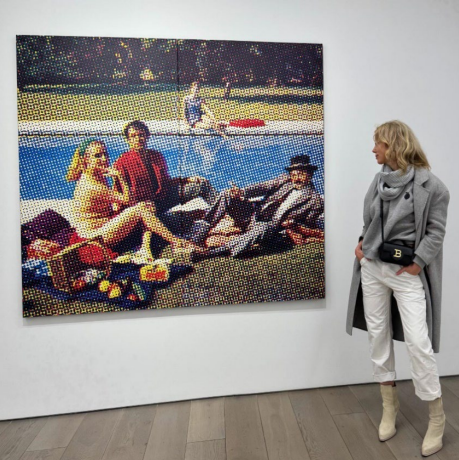
What do a dreamy Renaissance painter, a scandal-stirring Parisian modernist, and a pop-art provocateur from the 1960s have in common? Surprisingly—a picnic.
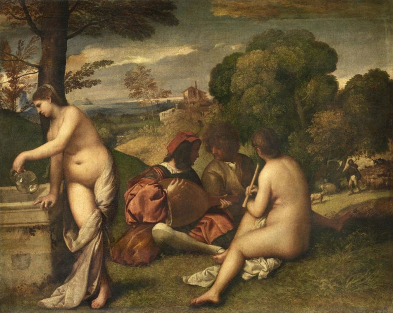
The Pastoral Concert Titian, 1509–1510
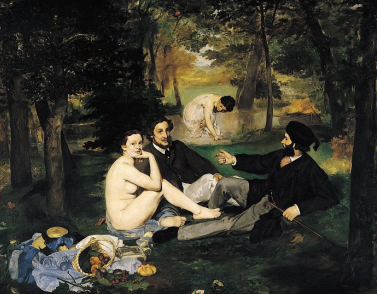
The Luncheon on the Grass Édouard Manet, 1863
Let’s start with the nudity—because art history always does.
Giorgione’s Pastoral Concert (c. 1510) is an enigmatic vision: two well-dressed young men play music, while two nude women wander the landscape like it’s a naturist retreat with excellent acoustics. Critics have debated for centuries whether the women are real, symbolic, invisible to the men, or just very confident in their skincare routine. Whatever the answer, Giorgione created a world where mythology, music, and mystery coexist in harmony—and no one is asking for an explanation. Fast-forward 350 years to Manet’s Le Déjeuner sur l’herbe (1863), and things get spicy. The nude woman is very real, very modern, and very much staring you down. Her name is Victorine Meurent, and she’s not pretending to be a nymph. She knows where she is: at a picnic with fully dressed men. And she knows you’re watching. Manet takes Giorgione’s pastoral dream and rips the veil off. The allegory is gone; what’s left is reality—with a side of social critique.
Giorgione’s Pastoral Concert (c. 1510) is an enigmatic vision: two well-dressed young men play music, while two nude women wander the landscape like it’s a naturist retreat with excellent acoustics. Critics have debated for centuries whether the women are real, symbolic, invisible to the men, or just very confident in their skincare routine. Whatever the answer, Giorgione created a world where mythology, music, and mystery coexist in harmony—and no one is asking for an explanation. Fast-forward 350 years to Manet’s Le Déjeuner sur l’herbe (1863), and things get spicy. The nude woman is very real, very modern, and very much staring you down. Her name is Victorine Meurent, and she’s not pretending to be a nymph. She knows where she is: at a picnic with fully dressed men. And she knows you’re watching. Manet takes Giorgione’s pastoral dream and rips the veil off. The allegory is gone; what’s left is reality—with a side of social critique.
Édouard Manet and the Birth of Modern Provocation in Art
One of the most pivotal moments in 19th-century art history centers on a single painting: Le Déjeuner sur l’herbe (Luncheon on the Grass, 1863) by Édouard Manet. This work not only sparked an immense public scandal but also heralded the arrival of a radically new way of seeing and making art. What caused such an uproar? Why was this painting, depicting an ordinary picnic, so controversial? The answer lies in both the subject matter and its presentation. When Manet submitted Le Déjeuner sur l’herbe to the official Paris Salon, it was rejected. Along with thousands of other works, it was excluded from what was then the most prestigious art exhibition in France. In response to the mass rejection, Emperor Napoleon III established the Salon des Refusés—the Salon of the Rejected—allowing the public to view the artworks deemed unworthy by the official jury. Among these was Manet’s provocative canvas. Manet drew inspiration from Renaissance masters, particularly Giorgione’s Pastoral Concert. Yet while Giorgione cloaked his figures in mythological symbolism and golden light, Manet did the opposite. He stripped away allegory and presented his subjects—recognizable Parisians of the time—in stark realism. The men in the painting were modeled after Manet’s brother and brother-in-law, and the nude woman was Victorine Meurent, a well-known artist’s model often associated with the image of the courtesan. The scandal arose not from the nudity itself—after all, nudes had long been part of the artistic canon—but from the fact that this woman was clearly not a goddess or muse. She was naked, not tastefully “nude,” and she stared back at the viewer with an unsettling, confident gaze. Her body, lit by harsh light, was devoid of the traditional idealizing glow, emphasizing her physical reality rather than an ethereal fantasy. This presentation made audiences deeply uncomfortable. It was no longer possible to pretend that art was only about beauty, mythology, or timeless ideals. Instead, Manet was holding up a mirror to modern society. His painting confronted viewers with the realities of contemporary life—its pleasures, hypocrisies, and moral contradictions. The presence of a known courtesan among bourgeois men was a pointed commentary on the pervasive but publicly unspoken culture of prostitution in 19th-century Paris. Manet challenged the bourgeois fantasy of moral superiority by making visible what society preferred to ignore. He was not alone: novelists like Émile Zola and Alexandre Dumas fils were also tackling these themes in literature, with works like Nana and La Dame aux Camélias.
One of the most pivotal moments in 19th-century art history centers on a single painting: Le Déjeuner sur l’herbe (Luncheon on the Grass, 1863) by Édouard Manet. This work not only sparked an immense public scandal but also heralded the arrival of a radically new way of seeing and making art. What caused such an uproar? Why was this painting, depicting an ordinary picnic, so controversial? The answer lies in both the subject matter and its presentation. When Manet submitted Le Déjeuner sur l’herbe to the official Paris Salon, it was rejected. Along with thousands of other works, it was excluded from what was then the most prestigious art exhibition in France. In response to the mass rejection, Emperor Napoleon III established the Salon des Refusés—the Salon of the Rejected—allowing the public to view the artworks deemed unworthy by the official jury. Among these was Manet’s provocative canvas. Manet drew inspiration from Renaissance masters, particularly Giorgione’s Pastoral Concert. Yet while Giorgione cloaked his figures in mythological symbolism and golden light, Manet did the opposite. He stripped away allegory and presented his subjects—recognizable Parisians of the time—in stark realism. The men in the painting were modeled after Manet’s brother and brother-in-law, and the nude woman was Victorine Meurent, a well-known artist’s model often associated with the image of the courtesan. The scandal arose not from the nudity itself—after all, nudes had long been part of the artistic canon—but from the fact that this woman was clearly not a goddess or muse. She was naked, not tastefully “nude,” and she stared back at the viewer with an unsettling, confident gaze. Her body, lit by harsh light, was devoid of the traditional idealizing glow, emphasizing her physical reality rather than an ethereal fantasy. This presentation made audiences deeply uncomfortable. It was no longer possible to pretend that art was only about beauty, mythology, or timeless ideals. Instead, Manet was holding up a mirror to modern society. His painting confronted viewers with the realities of contemporary life—its pleasures, hypocrisies, and moral contradictions. The presence of a known courtesan among bourgeois men was a pointed commentary on the pervasive but publicly unspoken culture of prostitution in 19th-century Paris. Manet challenged the bourgeois fantasy of moral superiority by making visible what society preferred to ignore. He was not alone: novelists like Émile Zola and Alexandre Dumas fils were also tackling these themes in literature, with works like Nana and La Dame aux Camélias.
Alain Jacquet: The Pop Picnic
Fast forward another hundred years, and French artist Alain Jacquet takes the scandalous scene and remixes it again—this time with screenprinting and satire. His Déjeuner sur l’herbe (1964) is part homage, part pop-cultural prank, and part philosophical jab. Jacquet didn’t just repaint Manet’s work; he photocopied it, pixelated it, populated it with his own friends, and turned it into a reproducible object. In Jacquet’s version, the figures include real-life contemporaries from the Paris art scene: art critic Pierre Restany (on the right), his wife Jeannine de Goldschmidt (on the left), painter Mario Schifano (in the center), and Jeannine’s sister Jacqueline Lafon (in the background). These aren’t anonymous symbols—they’re known faces, now frozen in a pixelated, mechanical eternity. Using the tools of Mec’Art (mechanical art), Jacquet made nearly 100 versions of this image, each slightly varied, embracing both mass production and playful repetition. The sacred picnic had become a reproducible meme. But don’t let the bright colors and irony fool you—Jacquet’s work still holds up a mirror. In his version, the bourgeois setting has morphed into the art world elite, lounging on the legacy of Manet’s rebellion while becoming part of the system he once critiqued. Is this still protest? Or parody? Or both?
