If you’ve ever wondered what a real art valuation report looks like, here’s a glimpse.
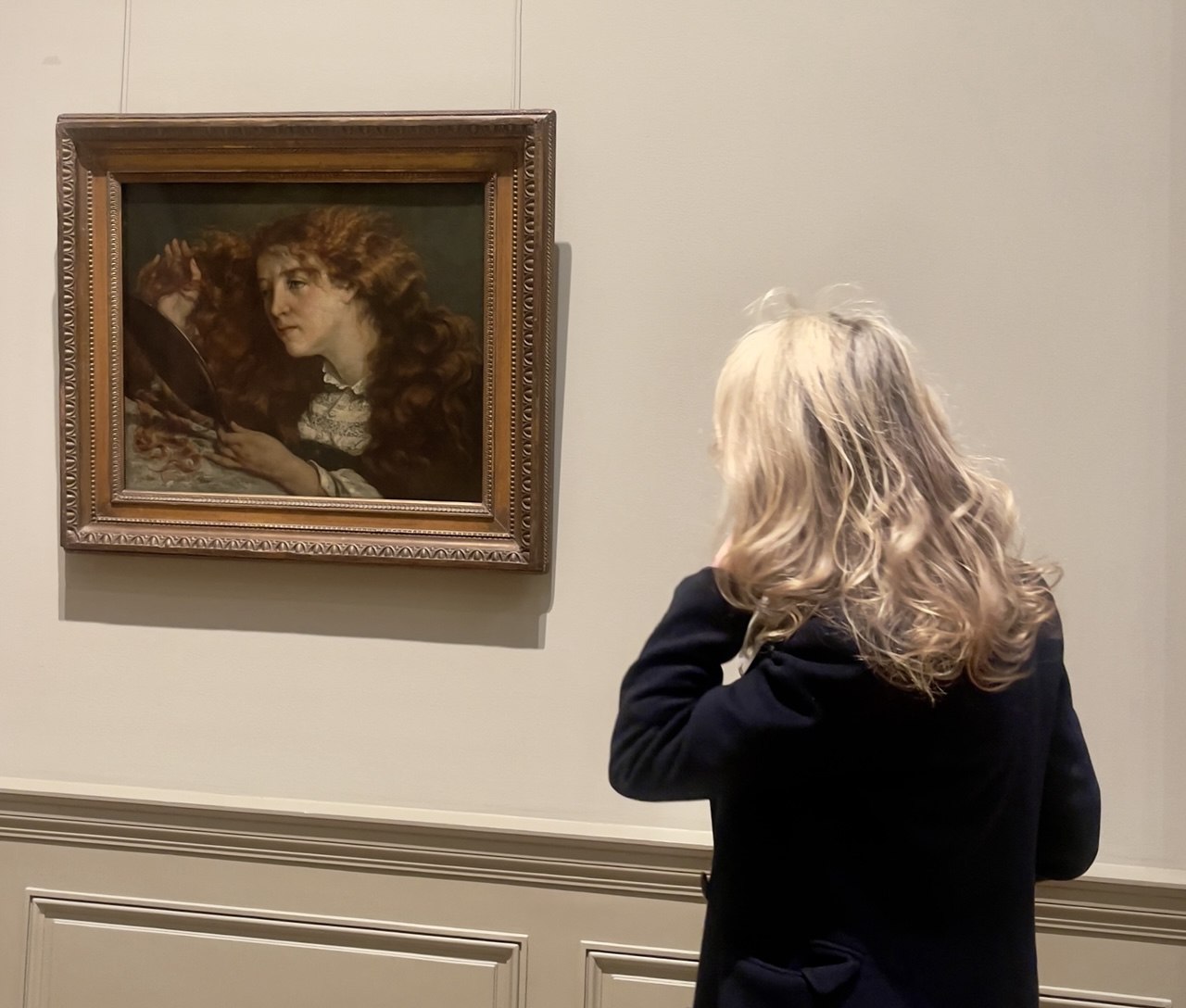
During my time in New York, I spent countless hours at The Met and the Watson Library, learning how to structure and deliver professional art valuations. It was intense, meticulous work—but this Courbet portrait became my “one love.”
Behind this red-haired beauty lies a story of the French countryside, rivalry, and clandestine studio visits. The woman depicted was not only Gustave Courbet’s lover but also the mistress of one of his close friends.
Yes, Courbet is known for his provocative nudes—like L’Origine du monde or Le Sommeil—but this more “humble” painting exudes a different kind of power. There’s a warmth and intimacy in her gaze that makes you feel Courbet simply couldn’t help but reveal his affection for her.
During my time in New York, I spent countless hours at The Met and the Watson Library, learning how to structure and deliver professional art valuations. It was intense, meticulous work—but this Courbet portrait became my “one love.”
Behind this red-haired beauty lies a story of the French countryside, rivalry, and clandestine studio visits. The woman depicted was not only Gustave Courbet’s lover but also the mistress of one of his close friends.
Yes, Courbet is known for his provocative nudes—like L’Origine du monde or Le Sommeil—but this more “humble” painting exudes a different kind of power. There’s a warmth and intimacy in her gaze that makes you feel Courbet simply couldn’t help but reveal his affection for her.
Description
Comparable Work (1)
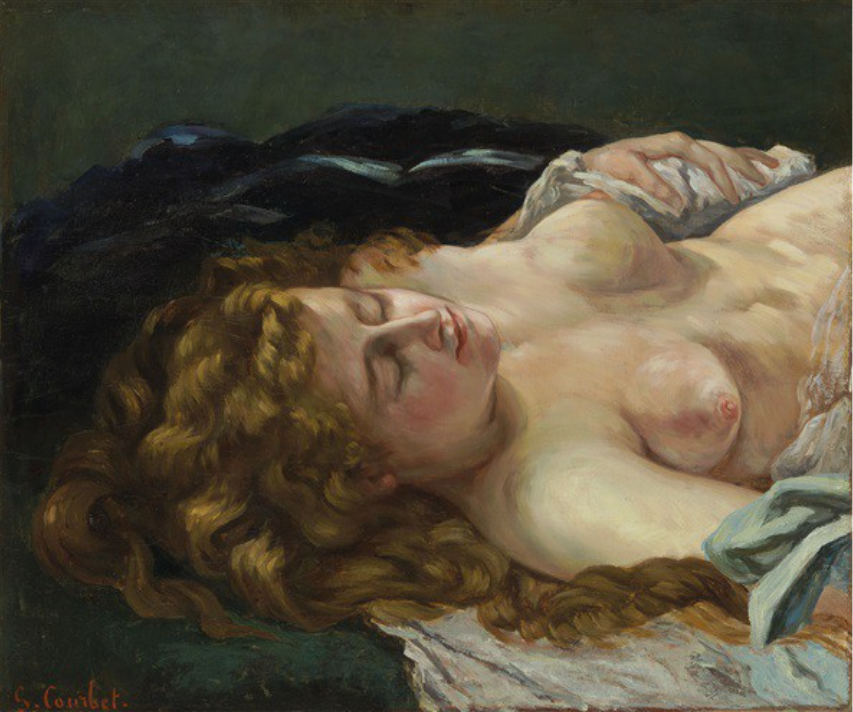
Title: Femme endormie aux cheveux roux, 1864
Gustave Courbet
Medium: Oil on canvas
Dimensions: 22 3/8 x 27 ½ in. (56.8 x 69.9 cm.)
Auction: Christie's New York [Lot 00008]
Auction Date: October 31, 2018
Estimate: 3.5 Million - 4.5 Million USD
Sold For: bought in
Gustave Courbet
Medium: Oil on canvas
Dimensions: 22 3/8 x 27 ½ in. (56.8 x 69.9 cm.)
Auction: Christie's New York [Lot 00008]
Auction Date: October 31, 2018
Estimate: 3.5 Million - 4.5 Million USD
Sold For: bought in
Comparable Work (2)
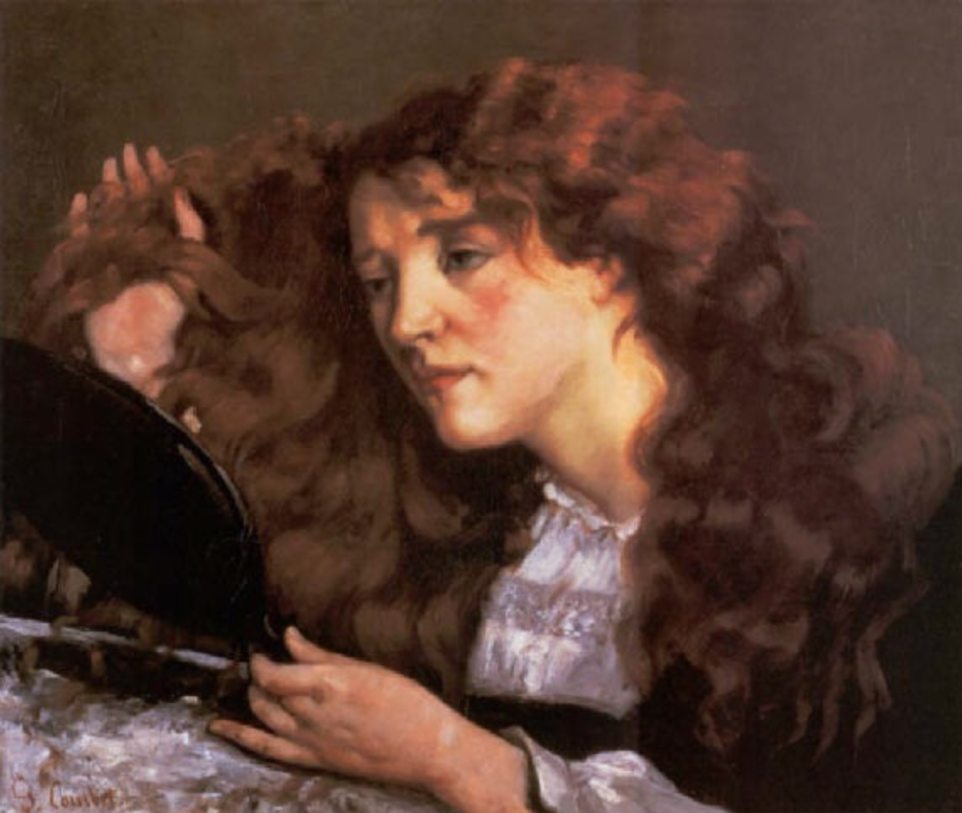
Title: Portrait de Jo, la belle Irlandaise, a copy
Gustave Courbet
Medium: Oil on canvas
Auction 1: Sotheby’s New York, May 13, 1998
Estimate: 2,000,000 - 3,000,000 USD
Hammer price: 2,972,500 USD
Sold For: 3,715,625 USD
Auction 2: Sotheby’s New York, 2001
Estimate: 1,000,000 - 1,500,000 USD
Hammer price: 1,875,750 USD
Sold for: 2,344,687 USD
Gustave Courbet
Medium: Oil on canvas
Auction 1: Sotheby’s New York, May 13, 1998
Estimate: 2,000,000 - 3,000,000 USD
Hammer price: 2,972,500 USD
Sold For: 3,715,625 USD
Auction 2: Sotheby’s New York, 2001
Estimate: 1,000,000 - 1,500,000 USD
Hammer price: 1,875,750 USD
Sold for: 2,344,687 USD
Comparable Work (3)
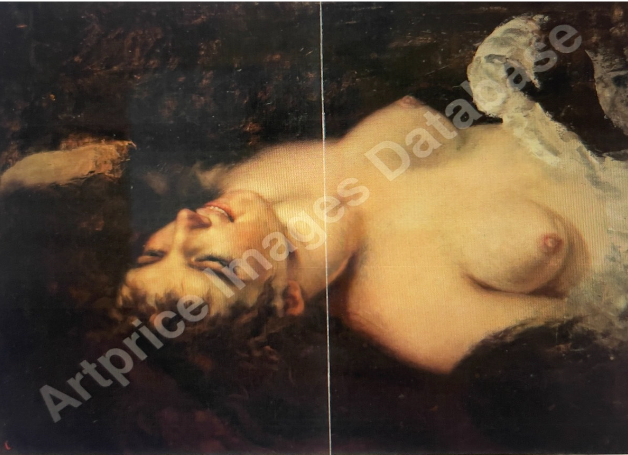
Title: Femme Nue, 1865-66
Medium: Oil on canvas
Dimensions: 23 5/8 x 28 7/8 in. (60 x 73,2 cm.)
Auction: Sotheby’s London, 2007
Estimate: 2,998,200 - 4,997,000 USD
Sold for: 3,286,027 USD
Medium: Oil on canvas
Dimensions: 23 5/8 x 28 7/8 in. (60 x 73,2 cm.)
Auction: Sotheby’s London, 2007
Estimate: 2,998,200 - 4,997,000 USD
Sold for: 3,286,027 USD
Analysis
Gustave Courbet was born in 1819 into an affluent landowning family in the village of Ornans, near the Swiss border. He studied at the Royal College in the nearby town, so his general education was solid, though his formal art training was mediocre. At 14 he took lessons from minor Neoclassical painter, that gave him foundation, later in life he would react against. In 1840, Gustave Courbet was sent to Paris to study law , but shortly after, her realized it wasn’t his path in life and with his father’s consent and support ( including financial) he pursued an artistic career instead.
Courbet avoided study in the studios of any of the period’s well-known artists, nor did he enroll in the top tier academic institutions for the arts in Paris. Instead he mostly taught himself by copying paintings by Caravaggio, Rubens and others in the Louvre, as well as Rembrandt and Velazquez, often replicating a classical painting again and again to uncover its secrets.
In the 1840s and early 1850s, Courbet developed his personal vision of Realism, which rejected any classical treatment or rhetoric. Although he was quite radical at the time, he still focused on being selected for the official French Salon – the annual juried exhibition administered by the French government and the Academy of Fine Arts. But, as he matured as an artist, he spurned the historical subjects prized by the Academy and painted scenes of modern life rendered in an emphatically realistic style, shocking his contemporaries.
In 1855, disgruntled at his rejection by the Salon jury, Courbet constructed a Pavilion of Realism within sight of the official Salon in which he displayed a one-man show of his works, accompanied by a manifesto that proclaimed his artistic philosophy. The decade that followed witnessed his triumph as the leader of the realist school.
Courbet joined the Paris Commune of 1871 and – following the collapse of the revolutionary government – was accused in participating in the destruction of the Vendôme column, ordered to pay a huge fine for its reconstruction, and imprisoned. In 1873, he fled to Switzerland, where he spent his remaining years in exile.
Talking about the period, when Courbet painted “Jo, La Belle Irlandaise” , which is 1865-66, artists’s focus was on erotic nudes, hunting scenes, landscapes, and seascapes. Courbet worked in all genres but being a lover of women, he glorified female beauty in paintings of stunning warmth and sensuality. He executed admirable portraits and the work, we are evaluating today, definitely “qualifies” to be regarded as Courbet’s masterpiece.
Before analyzing works comparable to Jo, La Belle Irlandaise, I would like to draw your attention to a number of facts that might have impact to the fair market value:
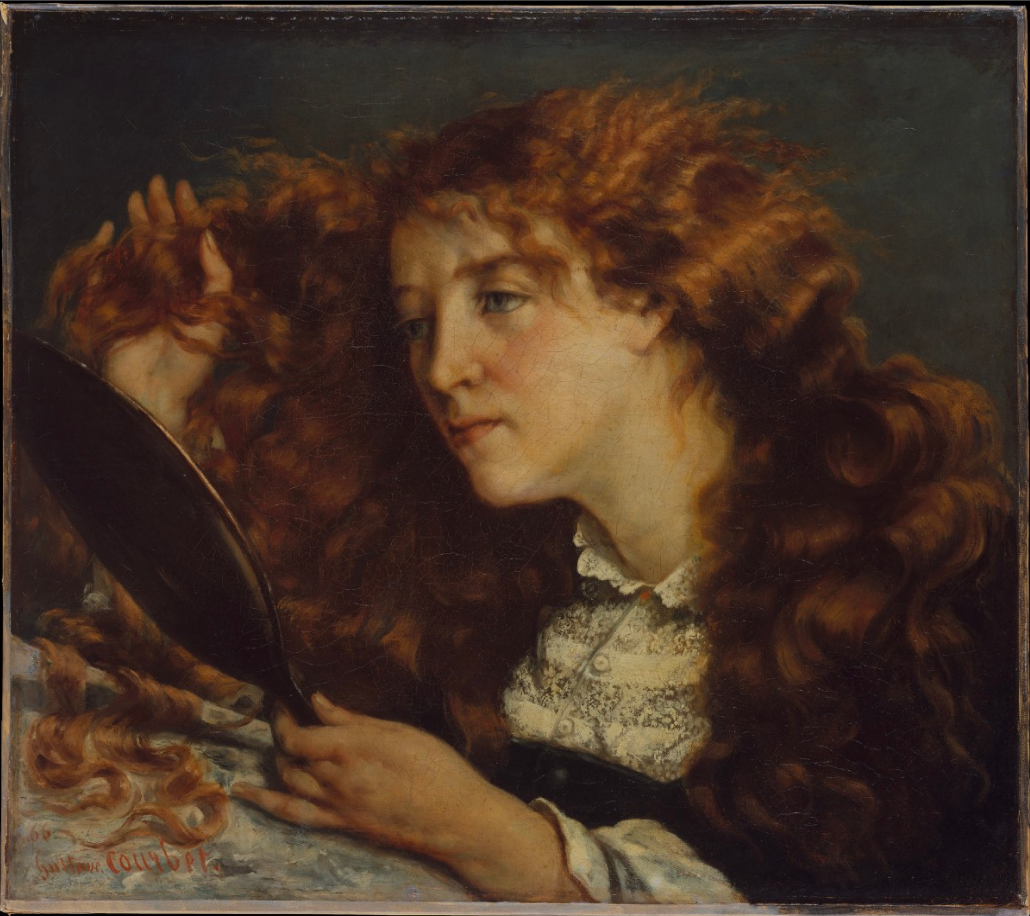
1. The "beautiful Irishwoman" depicted in this painting is Joanna Hiffernan (born 1842/43), mistress and model of the artist James McNeill Whistler (1834–1903), and perhaps subsequently Courbet’s lover. Although dated 1866, the picture was likely undertaken in 1865, when the two men painted together at the French seaside resort of Trouville; Courbet wrote of "the beauty of a superb redhead whose portrait I have begun.” Affection between the artist and the model undeniably added intimacy to the painting , that exudes tenderness and passion with which Courbet depicted woman’s features. Art critic Théophile Thoré wrote: "The flesh tones are of rare subtlety and recall the work of the greatest colorists, even [Italian Renaissance artist] Correggio. One may find that M. Courbet’s style is vulgar, that he seeks strangeness in his choice of subjects, and whatever you like, but he certainly is a first-rate practitioner and a very striking colorist.” Market and some collectors in particular might add extra value to “the love story“ behind the painting.
2. It was not unusual for Courbet to make replicas of existing paintings as demonstrated by the four known versions of Jo, La Belle Irlandaise. The reasons for multiple or duplicate versions of paintings simply resulted from supply-and-demand, and in the 1860s, market forces dictated Courbet’s willingness to paint replicas, especially depictions of the female nude. The three replicas of this painting are in the Nationalmuseum, Stockholm (F537), the Nelson-Atkins Museum of Art, Kansas City (F539), and a private collection in Zurich. It is believed, that “our” painting was the first one to be created. The dimensions and features of each of these four are relatively similar. Perhaps the main differences between the paintings are in the colour balance and the extent to which Jo's hair shows off the beauty of its red celtic tones.
3. Whilst female models were clearly common in art history, going back many centuries, it was rare for an artist to actually name them within the title of the painting. By doing so here, it reminds us as to just how close these two were.
I’d like to begin my analysis of works comparable with Jo, La Belle Irlandaise with “Femme endormie aux cheveux roux” (1) , because it is the most recent example of similar painting I was able to find at the the auction. In both paintings the young model individuality being central, capturing viewers attention. Both paintings are similar in size and are from the same period, both have meticulous provenance and exhibition history, with Femme endormie aux cheveux roux being a nude, which is a very strong market value driver. The estimate of Femme endormie aux cheveux roux was set at the level of the high estimate 4 500 000 USD, also because it was one of three paintings leading the auction. However, it was bought-in.
My second comparable is one of the three similar autograph versions, also titled ‘’Jo, la Belle Irlaindaise”. In both Hiffernan is shown in bust- length and three quarter profile, wearing a white blouse with delicate lacework and posing before the table. In one hand she holds a mirror into which she gazes intently. In the other, she runs thick strands of hair through her fingers, perhaps admiring the reflections of auburn, coopers, and browns.
The present work is generally accepted to be the first rendition with the most refined and delicate treatment of the lace and buttons on Hiffernan’s blouse as well as articulation of her hair.
My third comparable work is “Femme Nue” and it also belongs to a group of intimate, bust length paintings produced by Courbet in the 1860s that depict women lost in the reverie. Although the details change from one painting to another, the group is generally characterized by the presentation of a fair-skinned young woman, frequently shown in profile and in varying states of undress.
George Riat, one of Courbet’s biographer was almost certain that Femme Nue was also modeled by Jo Hiffernan. While the model in Femme Nue has much darker tresses, Courbet often altered a model's hair colour in other paintings, and otherwise the critical facial features of long, lush eyebrows, pointed and lightly dimpled chin, full cheeks and plump throat are strikingly similar.
Femme Nue might very well have been posed by Jo at the same moment as Jo, La Belle Irlandaise , but , It seems more likely however, that Courbet painted the nude , when Jo visited Courbet alone in Paris later in the year when Whistler was travelling abroad. Such a rendezvous, very likely clandestine, gave Courbet further reason to veil the sitters identity.
Gustave Courbet’s work has been popular outside France for a very long time. His thirteen best auction results were all hammered in England and the United States and his current auction record – $15.3 million for “Femme nue couchée” (1862) – was set by Christie’s New York in 2015. An exceptional amount for an exceptional painting.
However, that result was, and has remained, quite exceptional because Courbet’s larger works are extremely rare at auction: less than 2% of his auction lots reach the million-dollar threshold. The core of his market consists of works fetching between $10,000 and $200,000, mostly small oils-on-canvas, landscapes measuring less than a square meter. Market for Courbet’s landscapes is stable after reaching its all-time high at around 2015 (which was linked with increasing popularity among collectors from Hong Kong and mainland China).
However Jo, La Belle Irlandaise, one of Courbet’s most beautiful genre-portraits as well as one of his own favourite paintings and it holds a special place in artists’s oeuvre .
I believe it is immune to extreme market fluctuations and even if we would see a readjustment of the market , regarding landscapes or seascapes, present painting has a potential to eventually increase in value , being very ”sexy” and desirable object for collectors and one of the Courbet’s true masterpieces. It is also a perfect example of Courbet’s trademark dark tonality achieved by use of reddish-brown grounding on the canvas. Present work is in the excellent condition, has an impeccable provenance and impressive exhibition history. It is the first and best rendition at the series of four. Even though it is not a nude, and as we can see from examples above Courbet works had a bumpy history at the auction sales, I believe that fair market value of this painting is 3 400 000 USD.
Courbet avoided study in the studios of any of the period’s well-known artists, nor did he enroll in the top tier academic institutions for the arts in Paris. Instead he mostly taught himself by copying paintings by Caravaggio, Rubens and others in the Louvre, as well as Rembrandt and Velazquez, often replicating a classical painting again and again to uncover its secrets.
In the 1840s and early 1850s, Courbet developed his personal vision of Realism, which rejected any classical treatment or rhetoric. Although he was quite radical at the time, he still focused on being selected for the official French Salon – the annual juried exhibition administered by the French government and the Academy of Fine Arts. But, as he matured as an artist, he spurned the historical subjects prized by the Academy and painted scenes of modern life rendered in an emphatically realistic style, shocking his contemporaries.
In 1855, disgruntled at his rejection by the Salon jury, Courbet constructed a Pavilion of Realism within sight of the official Salon in which he displayed a one-man show of his works, accompanied by a manifesto that proclaimed his artistic philosophy. The decade that followed witnessed his triumph as the leader of the realist school.
Courbet joined the Paris Commune of 1871 and – following the collapse of the revolutionary government – was accused in participating in the destruction of the Vendôme column, ordered to pay a huge fine for its reconstruction, and imprisoned. In 1873, he fled to Switzerland, where he spent his remaining years in exile.
Talking about the period, when Courbet painted “Jo, La Belle Irlandaise” , which is 1865-66, artists’s focus was on erotic nudes, hunting scenes, landscapes, and seascapes. Courbet worked in all genres but being a lover of women, he glorified female beauty in paintings of stunning warmth and sensuality. He executed admirable portraits and the work, we are evaluating today, definitely “qualifies” to be regarded as Courbet’s masterpiece.
Before analyzing works comparable to Jo, La Belle Irlandaise, I would like to draw your attention to a number of facts that might have impact to the fair market value:
1. The "beautiful Irishwoman" depicted in this painting is Joanna Hiffernan (born 1842/43), mistress and model of the artist James McNeill Whistler (1834–1903), and perhaps subsequently Courbet’s lover. Although dated 1866, the picture was likely undertaken in 1865, when the two men painted together at the French seaside resort of Trouville; Courbet wrote of "the beauty of a superb redhead whose portrait I have begun.” Affection between the artist and the model undeniably added intimacy to the painting , that exudes tenderness and passion with which Courbet depicted woman’s features. Art critic Théophile Thoré wrote: "The flesh tones are of rare subtlety and recall the work of the greatest colorists, even [Italian Renaissance artist] Correggio. One may find that M. Courbet’s style is vulgar, that he seeks strangeness in his choice of subjects, and whatever you like, but he certainly is a first-rate practitioner and a very striking colorist.” Market and some collectors in particular might add extra value to “the love story“ behind the painting.
2. It was not unusual for Courbet to make replicas of existing paintings as demonstrated by the four known versions of Jo, La Belle Irlandaise. The reasons for multiple or duplicate versions of paintings simply resulted from supply-and-demand, and in the 1860s, market forces dictated Courbet’s willingness to paint replicas, especially depictions of the female nude. The three replicas of this painting are in the Nationalmuseum, Stockholm (F537), the Nelson-Atkins Museum of Art, Kansas City (F539), and a private collection in Zurich. It is believed, that “our” painting was the first one to be created. The dimensions and features of each of these four are relatively similar. Perhaps the main differences between the paintings are in the colour balance and the extent to which Jo's hair shows off the beauty of its red celtic tones.
3. Whilst female models were clearly common in art history, going back many centuries, it was rare for an artist to actually name them within the title of the painting. By doing so here, it reminds us as to just how close these two were.
I’d like to begin my analysis of works comparable with Jo, La Belle Irlandaise with “Femme endormie aux cheveux roux” (1) , because it is the most recent example of similar painting I was able to find at the the auction. In both paintings the young model individuality being central, capturing viewers attention. Both paintings are similar in size and are from the same period, both have meticulous provenance and exhibition history, with Femme endormie aux cheveux roux being a nude, which is a very strong market value driver. The estimate of Femme endormie aux cheveux roux was set at the level of the high estimate 4 500 000 USD, also because it was one of three paintings leading the auction. However, it was bought-in.
My second comparable is one of the three similar autograph versions, also titled ‘’Jo, la Belle Irlaindaise”. In both Hiffernan is shown in bust- length and three quarter profile, wearing a white blouse with delicate lacework and posing before the table. In one hand she holds a mirror into which she gazes intently. In the other, she runs thick strands of hair through her fingers, perhaps admiring the reflections of auburn, coopers, and browns.
The present work is generally accepted to be the first rendition with the most refined and delicate treatment of the lace and buttons on Hiffernan’s blouse as well as articulation of her hair.
My third comparable work is “Femme Nue” and it also belongs to a group of intimate, bust length paintings produced by Courbet in the 1860s that depict women lost in the reverie. Although the details change from one painting to another, the group is generally characterized by the presentation of a fair-skinned young woman, frequently shown in profile and in varying states of undress.
George Riat, one of Courbet’s biographer was almost certain that Femme Nue was also modeled by Jo Hiffernan. While the model in Femme Nue has much darker tresses, Courbet often altered a model's hair colour in other paintings, and otherwise the critical facial features of long, lush eyebrows, pointed and lightly dimpled chin, full cheeks and plump throat are strikingly similar.
Femme Nue might very well have been posed by Jo at the same moment as Jo, La Belle Irlandaise , but , It seems more likely however, that Courbet painted the nude , when Jo visited Courbet alone in Paris later in the year when Whistler was travelling abroad. Such a rendezvous, very likely clandestine, gave Courbet further reason to veil the sitters identity.
Gustave Courbet’s work has been popular outside France for a very long time. His thirteen best auction results were all hammered in England and the United States and his current auction record – $15.3 million for “Femme nue couchée” (1862) – was set by Christie’s New York in 2015. An exceptional amount for an exceptional painting.
However, that result was, and has remained, quite exceptional because Courbet’s larger works are extremely rare at auction: less than 2% of his auction lots reach the million-dollar threshold. The core of his market consists of works fetching between $10,000 and $200,000, mostly small oils-on-canvas, landscapes measuring less than a square meter. Market for Courbet’s landscapes is stable after reaching its all-time high at around 2015 (which was linked with increasing popularity among collectors from Hong Kong and mainland China).
However Jo, La Belle Irlandaise, one of Courbet’s most beautiful genre-portraits as well as one of his own favourite paintings and it holds a special place in artists’s oeuvre .
I believe it is immune to extreme market fluctuations and even if we would see a readjustment of the market , regarding landscapes or seascapes, present painting has a potential to eventually increase in value , being very ”sexy” and desirable object for collectors and one of the Courbet’s true masterpieces. It is also a perfect example of Courbet’s trademark dark tonality achieved by use of reddish-brown grounding on the canvas. Present work is in the excellent condition, has an impeccable provenance and impressive exhibition history. It is the first and best rendition at the series of four. Even though it is not a nude, and as we can see from examples above Courbet works had a bumpy history at the auction sales, I believe that fair market value of this painting is 3 400 000 USD.
Bibliography
Galitz, Kathryn Calley. “Gustave Courbet (1819–1877).” In Heilbrunn Timeline of Art History. New York: The Metropolitan Museum of Art, 2000,
http://www.metmuseum.org/toah/hd/gust/hd_gust.htm (May 2009).
Chu, Petra ten-Doesschate, ed. Letters of Gustave Courbet. Chicago: University of Chicago Press, 1992.
Clarke, T. J. Image of the People: Gustave Courbet and the Second French Republic, 1848–1851. Greenwich, Conn.: New York Graphic Society, 1973.
Gustave Courbet. Exhibition catalogue. New York: Metropolitan Museum of Art, 2008.
Nochlin, Linda. Courbet. New York: Thames & Hudson, 2007.
Gustave Courbet. Letter [to Bruyas?]. 1865 [published in P. Borel, "Le Roman de Gustave Courbet," Paris, 1922, p. 99 n. 1, and in J. Rewald, "The History of Impressionism," New York, 1946, p. 113], states that he has begun the portrait of a beautiful red-headed girl.
Léonce Bénédite. Courbet. Paris, [1912], p. 92, pl. 38, calls this work a replica of the version exhibited at Besançon in 1868 (Nationalmuseum, Stockholm; F537).
Théodore Duret. Courbet. Paris, 1918, pp. 129–30, states that Courbet painted two versions of this composition.
B[ryson]. B[urroughs]. "The Gustave Courbet Centenary Exhibition." Metropolitan Museum of Art Bulletin 14 (April 1919), p. 74, ill. p. 73.
Arsène Alexandre. "La Collection Havemeyer: Courbet et Corot." La Renaissance 12 (June 1929), pp. 276, 278, ill. on cover.
R. H. Wile[n]ski. French Painting. Boston, 1931, p. 224, as "The Girl with the Mirror: Whistlers 'Jo'"; mentions another version of this picture at Reid and Lefevre, London (now private collection).
Sotheby's: Fine Art, Jewels, Watches, Wine Auctions & Sales,
https://www.sothebys.com
Christie's | Fine Art, Luxury & Antiques | Auctions & Private Sales,
https://www.christies.com
The Metropolitan Museum of Art,
https://www.metmuseum.org
http://www.metmuseum.org/toah/hd/gust/hd_gust.htm (May 2009).
Chu, Petra ten-Doesschate, ed. Letters of Gustave Courbet. Chicago: University of Chicago Press, 1992.
Clarke, T. J. Image of the People: Gustave Courbet and the Second French Republic, 1848–1851. Greenwich, Conn.: New York Graphic Society, 1973.
Gustave Courbet. Exhibition catalogue. New York: Metropolitan Museum of Art, 2008.
Nochlin, Linda. Courbet. New York: Thames & Hudson, 2007.
Gustave Courbet. Letter [to Bruyas?]. 1865 [published in P. Borel, "Le Roman de Gustave Courbet," Paris, 1922, p. 99 n. 1, and in J. Rewald, "The History of Impressionism," New York, 1946, p. 113], states that he has begun the portrait of a beautiful red-headed girl.
Léonce Bénédite. Courbet. Paris, [1912], p. 92, pl. 38, calls this work a replica of the version exhibited at Besançon in 1868 (Nationalmuseum, Stockholm; F537).
Théodore Duret. Courbet. Paris, 1918, pp. 129–30, states that Courbet painted two versions of this composition.
B[ryson]. B[urroughs]. "The Gustave Courbet Centenary Exhibition." Metropolitan Museum of Art Bulletin 14 (April 1919), p. 74, ill. p. 73.
Arsène Alexandre. "La Collection Havemeyer: Courbet et Corot." La Renaissance 12 (June 1929), pp. 276, 278, ill. on cover.
R. H. Wile[n]ski. French Painting. Boston, 1931, p. 224, as "The Girl with the Mirror: Whistlers 'Jo'"; mentions another version of this picture at Reid and Lefevre, London (now private collection).
Sotheby's: Fine Art, Jewels, Watches, Wine Auctions & Sales,
https://www.sothebys.com
Christie's | Fine Art, Luxury & Antiques | Auctions & Private Sales,
https://www.christies.com
The Metropolitan Museum of Art,
https://www.metmuseum.org
